Publications
Publications and work in progress in reversed chronological order.
2026
-
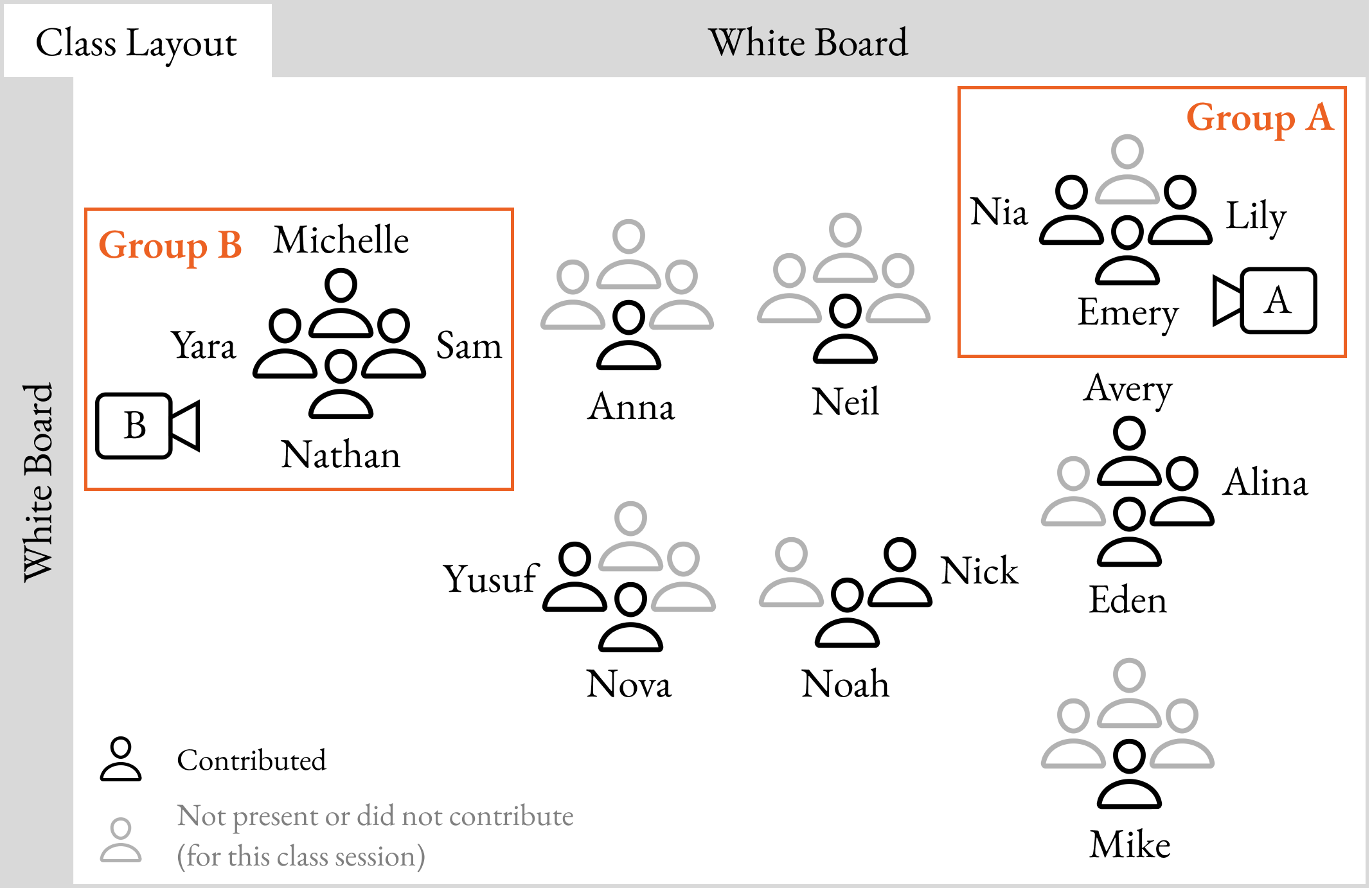 Qiu, R. N. (in press)Exploring the relationship between group roles and participation patterns in an inquiry-based mathematics courseIn Proceedings of the 28th Annual Conference on Research in Undergraduate Mathematics Education.
This report examines how group roles and instructional practices shaped student participation in an inquiry-oriented undergraduate mathematics course. Using classroom video with thematic analysis and equity analytics, findings indicate alignment with the four pillars of Inquiry-Based Mathematics Education (IBME). The role responsible for reporting to the class (called reporter) most clearly influenced participation, while other roles were taken up more fluidly as students responded to the needs of the group’s mathematical exploration. The results suggest that IBME design fosters collaborative learning while also highlighting opportunities for future research on how group roles and instructional practices can be refined to support equitable participation.
@inproceedings{qiu2026RUME_EQUIP, author = {Qiu, R. N.}, title = {Exploring the relationship between group roles and participation patterns in an inquiry-based mathematics course}, booktitle = {Proceedings of the 28th Annual Conference on Research in Undergraduate Mathematics Education}, year = {2026}, note = {in press}, address = {Alexandria, VA}, publisher = {SIGMAA on RUME}, organization = {Virginia Tech}, keywords = {Group roles, Equity QUantified in Participation, Inquiry-Based Mathematics Education}, apasort = {Qiu|0|2026|Exploring the relationship between group roles and participation patterns}, } -
 Rasmussen, C., Qiu, R. N., Carney, D., Ponce, M., Fortune, N., Jacome, N. & Stewart, M. (in press)Making upper division math courses more relevant for prospective teachersIn Proceedings of the 28th Annual Conference on Research in Undergraduate Mathematics Education.
In this report we address the longstanding problem of the perceived relevance of upper division math courses for prospective secondary school teachers. Through a multi-year design-based research approach we are reimaging a Dynamical Systems and Modeling course and investigating ways to make the course more relevant to prospective teachers. In this work we report on the impact of these efforts on students’ relational understanding of why a particular function is a horizontal shift to the left of another function, a high school topic that is often only instrumentally taught and understood. Analysis of beginning and mid-semester assessments indicate significant growth in our students’ ability to provide meaningful explanations. We also report on students’ perspectives on classroom activities that influenced their reasoning.
@inproceedings{rasmussen2026, author = {Rasmussen, C. and Qiu, R. N. and Carney, D. and Ponce, M. and Fortune, N. and Jacome, N. and Stewart, M.}, title = {Making upper division math courses more relevant for prospective teachers}, booktitle = {Proceedings of the 28th Annual Conference on Research in Undergraduate Mathematics Education}, year = {2026}, note = {in press}, keywords = {Function Translation, University-Secondary Mathematics Connections, Prospective Teachers}, apasort = {Rasmussen|1|Qiu|Carney|Ponce|Fortune|Jacome|Stewart|2026|Making upper division math courses more relevant for prospective teachers}, } -
 Aniceto, R. G., Delaney, V. & Qiu, R. N. (in press)Prospective teachers’ model-building of student thinking on sampling distributionsIn Proceedings of the 28th Annual Conference on Research in Undergraduate Mathematics Education.
Prospective secondary mathematics and statistics teachers (PSTs) should have opportunities to analyze student work and construct “second-order models” of student thinking—that is, PSTs’ conceptions of students’ thinking informed by their observations and knowledge for teaching. We report findings from a qualitative analysis of group discussions in a curriculum course where PSTs constructed second-order models in response to hypothetical students’ statements about sampling distributions. The analysis revealed productive engagement with key statistical ideas and evidence of elaborate forms of second-order model-building while also revealing opportunities to more comprehensively attend to the features of the sampling distribution concept. Additionally, this work contributes to existing literature documenting PSTs’ understandings of the sampling distribution concept. More broadly, our work suggests that engaging PSTs in second-order model-building can help teacher educators surface and address underemphasized statistical ideas, supporting deeper content knowledge for teaching.
@inproceedings{ancieto2026RUME_sampling_dist,
  author = {Aniceto, R. G. and Delaney, V. and Qiu, R. N.},
  title = {Prospective teachers’ model-building of student thinking on sampling distributions},
  booktitle = {Proceedings of the 28th Annual Conference on Research in Undergraduate Mathematics Education},
  year = {2026},
  note = {in press},
  keywords = {Sampling Distributions, Prospective Teachers, Second-order Modelling},
  apasort = {Aniceto|0|2026|Prospective teachers’ model-building of student thinking on sampling distributions},
}
2025
-
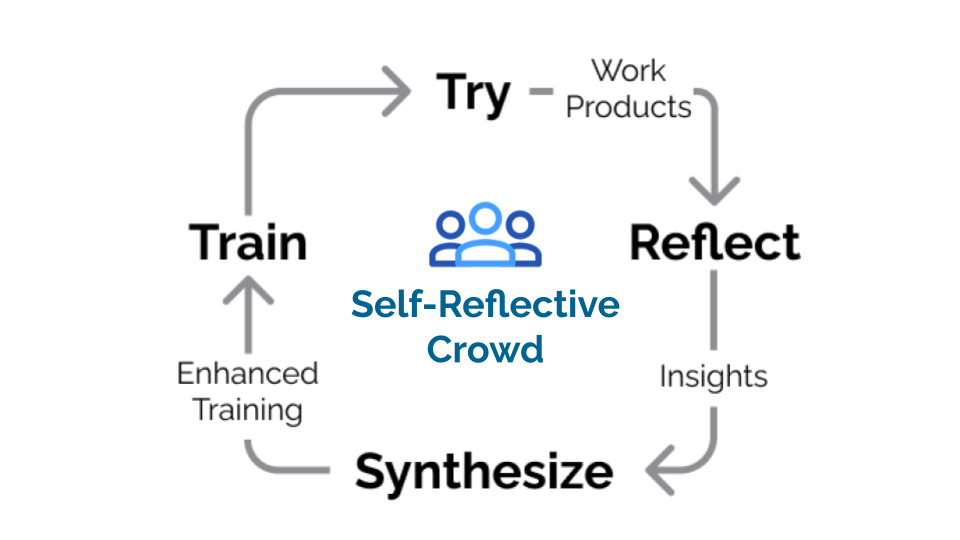 Qiu, R. N., Vadaparty, A., Vintha, S. & Dow, S. P. (2025)Self-reflective crowds: surfacing wisdom through emergent scaffoldingIn Proceedings of the ACM Collective Intelligence Conference, 169–187.
Producing open-ended creative work through crowdsourcing remains a challenge, as workers often lack domain expertise, and requesters struggle to provide scalable guidance. Can the workers themselves create materials that guide subsequent workers? In this paper, we prototype a workflow for emergent scaffolding, where hints, rubrics, and examples are generated by crowd workers after attempting the task. We demonstrate how an iterative Train-Try-Reflect-Synthesize pattern—supported by LLMs—can produce a structured rubric with graded examples to guide subsequent workers on a task to create digital illustrations for scientific papers. To evaluate this strategy, we conducted a between-subjects experiment with three conditions: baseline instructions, generic examples, and emergent scaffolding. Participants in the emergent scaffolding condition created significantly better illustrations, as rated by blind-to-condition judges, compared to generic examples or instructions only. While self-efficacy ratings were mixed across conditions, emergent scaffolding participants provided better feedback during their post-task reflections. We discuss the potential for emergent scaffolding to support and scale up complex, creative tasks in crowdwork.
@inproceedings{qiu2025emergentscaffolding, author = {Qiu, R. N. and Vadaparty, A. and Vintha, S. and Dow, S. P.}, title = {Self-reflective crowds: Surfacing wisdom through emergent scaffolding}, year = {2025}, isbn = {9798400714894}, publisher = {Association for Computing Machinery}, address = {New York, NY, USA}, url = {https://doi.org/10.1145/3715928.3737478}, doi = {10.1145/3715928.3737478}, booktitle = {Proceedings of the ACM Collective Intelligence Conference}, pages = {169--187}, numpages = {19}, keywords = {Crowdsourcing, Learnersourcing, Scaffolding, Creative Work}, series = {CI '25}, apasort = {Qiu|1|Vadaparty|Vintha|Dow|2025|Self-reflective crowds: Surfacing wisdom through emergent scaffolding}, } -
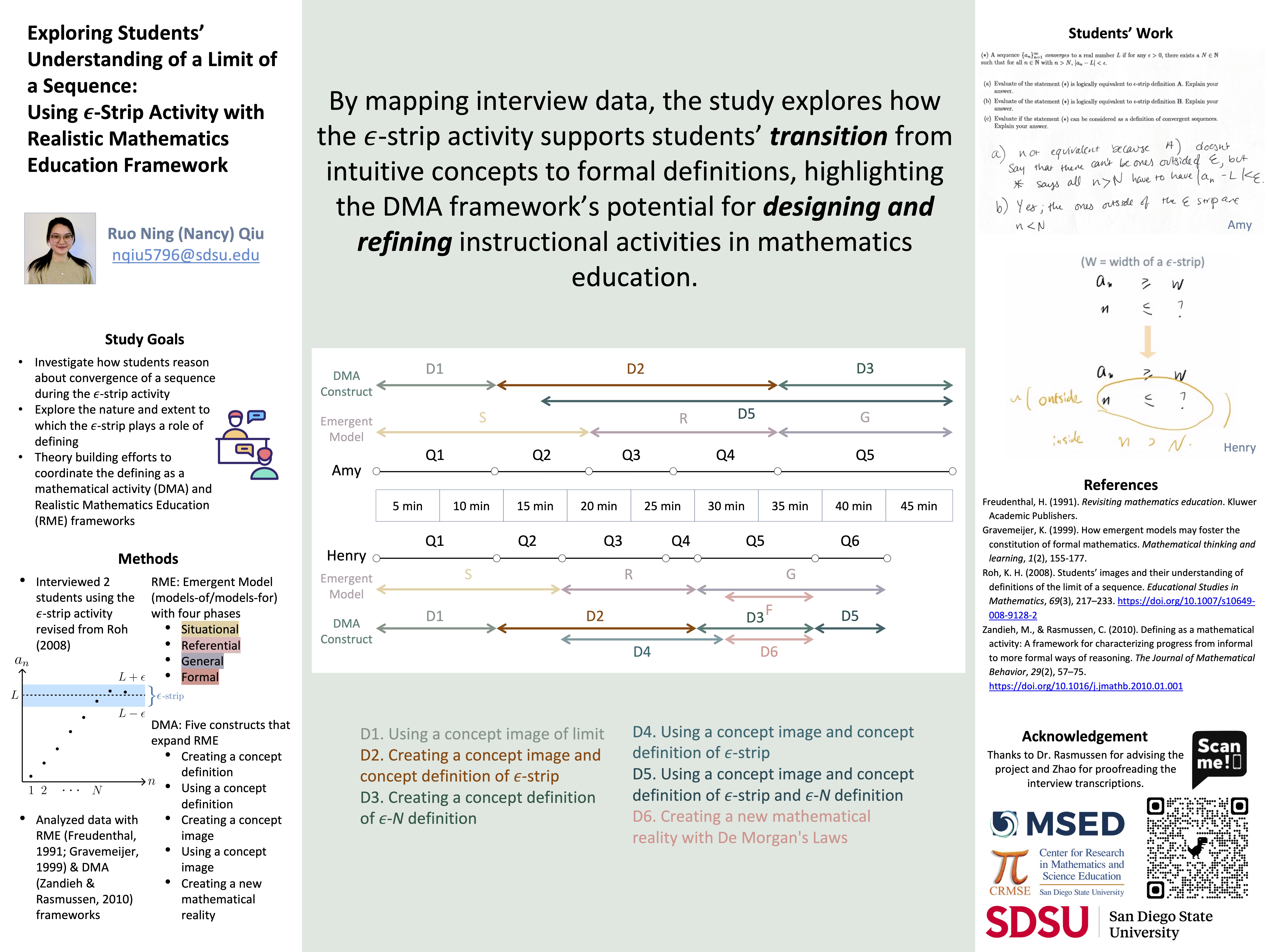 Qiu, R. N. (2025)Exploring students’ understanding of a limit of a sequence: using ε-strip activity with realistic mathematics education frameworkIn Proceedings of the 27th Annual Conference on Research in Undergraduate Mathematics Education, 1404–1405.
Many studies showed that students find it challenging to develop a proper understanding of the rigorous ε-N definition of a convergent sequence in relation to the concept of limit, a crucial building block to help students make sense of formalized mathematical statements. In the study, I interviewed two students with the ε-strip activity to examine how they reasoned about sequence convergence and analyzed the interview data to inspect whether ε-strip plays the role of defining in student progress from informal to more formal ways of reasoning as a mathematical activity, in other words, to theorize the ε-strip activity with the defining as a mathematical activity (DMA) framework that expands realistic mathematics education (RME). The results reconfirmed the effectiveness of how ε-strip activity scaffolds the rigorous ε-N definition and supported the practicability of DMA and RME to guide instructional task design.
@inproceedings{qiu2025limit, author = {Qiu, R. N.}, title = {Exploring students’ understanding of a limit of a sequence: Using $\epsilon$-strip activity with Realistic Mathematics Education framework}, booktitle = {Proceedings of the 27th Annual Conference on Research in Undergraduate Mathematics Education}, editor = {Cook, S. and Katz, B. P. and Melhuish, K.}, pages = {1404--1405}, year = {2025}, address = {Alexandria, VA}, publisher = {SIGMAA on RUME}, organization = {Virginia Tech}, keywords = {$\epsilon$-strip Activity, Realistic Mathematics Education, Defining as a Mathematical Activity}, apasort = {Qiu|0|2025|Exploring students' understanding of a limit of a sequence}, } -
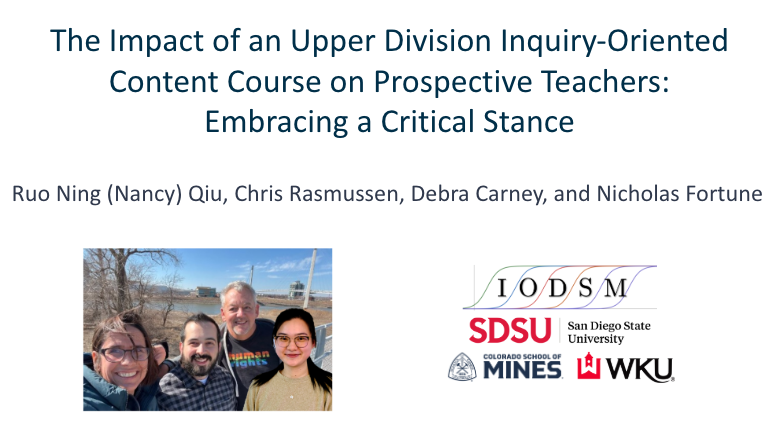 Qiu, R. N., Rasmussen, C., Carney, D. & Fortune, N. (2025)The impact of an upper division inquiry-oriented content course on prospective teachers: embracing a critical stanceIn Proceedings of the 27th Annual Conference on Research in Undergraduate Mathematics Education, 346–354.
In this study, we analyze interviews with prospective secondary school teachers focused on how an upper division inquiry-oriented content course influenced their beliefs about learning and teaching mathematics. In particular, we examine how students describe their experiences in this course and the extent to which (and why) students see themselves using an inquiry-oriented instructional approach in their future teaching. Using thematic analysis, we found that the ways prospective teachers described their experiences in the course aligned closely with the four pillars of Inquiry-Based Mathematics Education, and the course empowered students to embrace a critical stance to self-reflect on their experiences and to raise their awareness of their agency to change things (for the better) through their own actions and future forms of instruction.
@inproceedings{qiu2025prospective,
  author = {Qiu, R. N. and Rasmussen, C. and Carney, D. and Fortune, N.},
  title = {The impact of an upper division inquiry-oriented content course on prospective teachers: Embracing a critical stance},
  booktitle = {Proceedings of the 27th Annual Conference on Research in Undergraduate Mathematics Education},
  editor = {Cook, S. and Katz, B. P. and Melhuish, K.},
  pages = {346--354},
  year = {2025},
  address = {Alexandria, VA},
  publisher = {SIGMAA on RUME},
  organization = {Virginia Tech},
  keywords = {Critical Stance, Inquiry, Prospective Teachers, Beliefs about Teaching},
  apasort = {Qiu|1|Rasmussen|Carney|Fortune|2025|The impact of an upper division inquiry-oriented content course on prospective teachers: Embracing a critical stance},
}