Teaching
 My Teaching Philosophy
I believe that mathematics is best learned by doing, not by passively copying notes or memorizing procedures. My teaching is grounded in inquiry-based, student-centered learning that prompts students to engage in mathematical thinking, collaborate with peers, and make sense of ideas collectively.
 Class Design
I have several years of experience facilitating active-learning lectures using strategies like Think-Pair-Share in linear algebra and first-year calculus courses. I am particularly interested in inquiry-based and inverted classroom models, where lectures become spaces for exploration and the instructor acts as a facilitator on the side.
 Assessment
My teaching is informed by a belief that mathematical thinking is not reserved for the “gifted” and that growth mindset and effort matter more than innate ability. I aim to design assessments, such as reflection assignments and collaborative projects, that support diverse learners and value multiple ways of engaging with mathematics. Assessment data should serve as feedback, offering instructors a window into students’ thinking and providing students with insights into their own learning processes.
 Broader Goal
Ultimately, I want students to build a relationship with mathematics that is empowering and meaningful, regardless of whether they pursue it professionally as mathematicians. I want to support students in following their aspirations, and mathematics is one of many tools they might find useful along the way.
University is a space for exploration, but institutional constraints like large class sizes and rigid program structures can limit how much one can support each individual student. Even so, I find deep joy in teaching: in witnessing the moments when a small classroom activity or a rich peer discussion sparks a student’s interest in mathematics. These moments mirror how I first fell in love with the subject, and they continue to inspire my commitment to teaching.
 TA Training & Professional Development
My involvement in supporting TA training began as an observation TA at the University of Toronto, where I provided formative feedback to new TAs by observing their discussion sections and helping them develop reflective teaching practices aligned with their goals.
At UBC, I continued this commitment by facilitating informal teaching lunches in the Mathematics Department, and by helping lead training workshops for new TAs of SCIE courses in the Faculty of Science.
To further develop my pedagogical skills, I completed a Mathematics Teaching Techniques course at the Mathematics Department, where I received personalized feedback on lesson planning and delivered a guest lecture, in preparation to teach undergraduate mathematics. I also participated in the Mathematics Instructional Skills Workshop (ISW) and the CIRTL Summer Teaching Institute’s Scholarship of Teaching and Learning Workshop, earning a CIRTL Associate certificate.
As part of a reflection activity in the ISW workshop, two fellow participants composed the following creative slant poem, in response to my mini-lesson teaching, a piece I found both touching and heartwarming:
The Feedback Poem
By Caleb and JackNancy, a teacher of math Nancy, if she were a graph, then Nancy, would be monotone increasing because Nancy, keeps her learners achieving. She’s organized and sweet, has origami art And always makes sure her learners are a part of cycle of Kolb, and I don’t mean Colby like the cheese Because Nancy is a teacher who will help you achieve your mathematical dreams Her learners come first, and her care is key Just like a fractal, her growth will be Going on and on from day 1 to infinity Nancy, peach out *mic drop*
 Designing a First-Year Cohort-Based Program
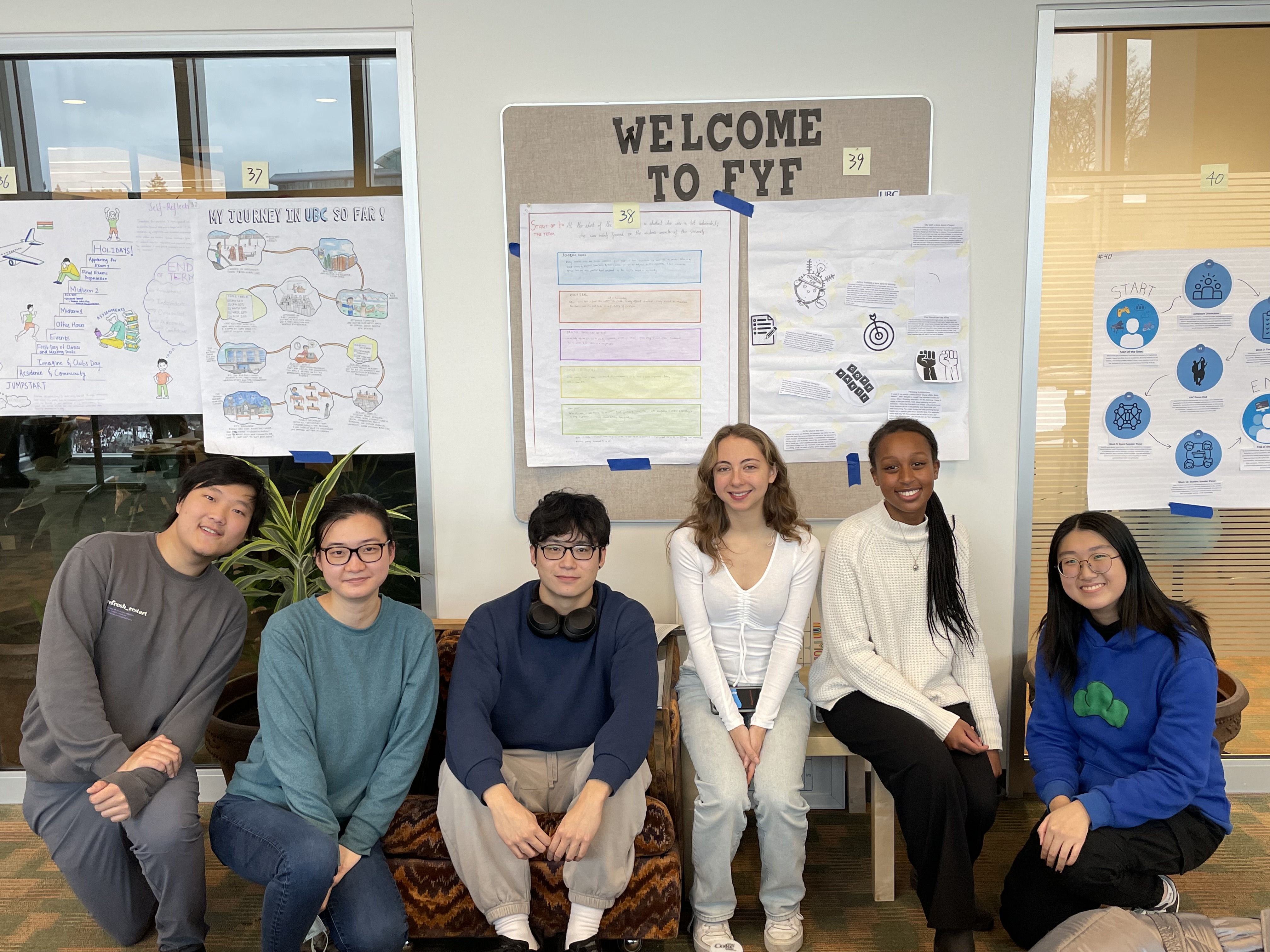
In parallel, I contributed to curriculum development for the First Year Focus program in the summer of 2022. As a graduate curriculum assistant, I helped design a cohort-based seminar course supporting first-year students’ transition to university. The course emphasized metacognitive skills, a sense of belonging, and exploration of disciplinary identity. In the following semester, I served as the graduate teaching assistant for the course. I led a team of six undergraduate TAs in facilitating tutorials and provided ongoing professional development. Below is a photo of the TA team at the end-of-semester portfolio day, where FYF students creatively showcased their academic and personal learning trajectories throughout the program.
 Teaching Experience
Teaching Methods in Computer Science
Fall 2024 & Fall 2025, CSE 599, UCSD
Mentor TA
Integral Calculus with Applications
Winter 2023, MATH 101, UBC
Small Class Instructor
First-Year Focus Seminar in the Computational Sciences
Summer 2022 & Fall 2022, SCIE 100, UBC
Graduate Curriculum Assistant and Teaching Assistant
Numerical Methods for Differential Equations
Fall 2022, MATH 405, UBC
Graduate Teaching Assistant
Mathematical Research and Writing
Winter 2022, MATH 444, UBC
Graduate Teaching Assistant
Integral Calculus with Applications to Commerce and Social Sciences
Winter 2022, MATH 105, UBC
Graduate Teaching Assistant
Calculus III
Fall 2021, MATH 200, UBC
Graduate Teaching Assistant
Linear Algebra I
Fall 2018, Winter 2019, Fall 2019, Winter 2020, Fall 2020, & Winter 2021, MAT223, UofT
Undergraduate Teaching Assistant
 Student Evaluations – MATH 101 (Winter 2023)
Each quote below comes from the open-ended section of anonymous course evaluation in response to the prompt: “Please comment on what your instructor did well to support your learning.”
 A15 Session
- “Changed structure as course progressed to better fit student needs.”
- “Overall great person. Cares about the class and changed techniques to better support the class.”
- “Made the math super fun and was very supportive of all aspects including mistakes.”
- “Gave individualized feedback, encouraged class participation even when it wasn’t entirely serious (this was helpful because these ‘funny’ moments were more memorable/helped remember important concepts), explained what changes would be made when she received feedback, great attitude.”
A28 Session
- “The instructor always helped if the students had any questions and ensured that the students had a thorough understanding of the material.”
- “Went through problems and explanations well.”
- “Their notes were very clear and easy to follow.”
- “Ruo Ning was very engaging and would motivate us to answer in class. She’d make it fun to learn by tying concepts to real-life applications. She also gave us some really good advice on the last day!”
- “Very clear instructions and always gave a summary and takeaway at the end of each topic.”
A37 Session
- “Was always clear and explained very thoroughly. Made sure to restate the things she already stated so students are on the right track.”
- “Good humor and easy to understand takeaways which summarize the class content.”
A42 Session
- “I like the way she explained about the course material, even sometimes relating to her own experience, which is something rarely seen from TAs. Her time management is also very great because she always manages to cover up all materials that should be taught in the small class.”
- “Allowed students to share their answers and how they got them.”
- “She was very considerate in terms of office hours and answering questions after small class. She also did a good job in picking which materials are the most important for the small class.”
- “The instructor was always motivated to teach and always tried to get everyone in class engaged.”
- “Nancy did her best to help us understand what we have learned during the lecture in the early time of each Tuesday and seems she really did that. She is nice and treats everyone with respect and helps us understand and love math.”
- “Engaging the class to answer the problems and has high motivation in the class, which has increased my participation.”
- “I liked her structure of lessons like using learning objectives and takeaways!”